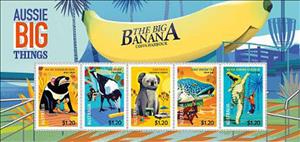
Souvenir Sheet: Aussie Big Things (Australia 2023)
Aussie Big Things (Australia 2023)
04 September (Australia ) within release Aussie Big Things (2023) goes into circulation Souvenir Sheet Aussie Big Things face value 5*1.20 Australian dollar
| Souvenir Sheet Aussie Big Things in catalogues | |
|---|---|
| Colnect codes: | Col: AU 2023.09.04-11 |
Souvenir Sheet is horizontal format.
Also in the issue Aussie Big Things (2023):
- Souvenir Sheet - Aussie Big Things face value 5*1.20;
- Stamp - Big Swoop, Canberra face value 1.20;
- Booklet - Big Swoop, Canberra face value 10*1.20;
- Stamp - Big Swoop, Canberra face value 1.20;
- Stamp - Giant Koala, Dadswells Ridge, Victoria face value 1.20;
- Booklet - Giant Koala, Dadswells Ridge, Victoria face value 10*1.20;
- Stamp - Giant Koala, Dadswells Ridge, Victoria face value 1.20;
- Stamp - Giant Murray Cod, Swan Hill, Victoria face value 1.20;
- Stamp - Giant Murray Cod, Swan Hill, Victoria face value 1.20;
- Booklet - Giant Murray Cod, Swan Hill, Victoria face value 10*1.20;
- Stamp - The Big Jumping Crocodile, Wak Wak, Northern Territory face value 1.20;
- Stamp - The Big Jumping Crocodile, Wak Wak, Northern Territory face value 1.20;
- Booklet - The Big Jumping Crocodile, Wak Wak, Northern Territory face value 10*1.20;
- Stamp - The Big Tasmanian Devil, Mole Creek, Tasmania face value 1.20;
- Stamp - The Big Tasmanian Devil, Mole Creek, Tasmania face value 1.20;
- Booklet - The Big Tasmanian Devil, Mole Creek, Tasmania face value 10*1.20;
Souvenir Sheet Aussie Big Things it reflects the thematic directions:
Animals are multicellular, eukaryotic organisms of the kingdom Animalia (also called Metazoa). All animals are motile, meaning they can move spontaneously and independently, at some point in their lives. Their body plan eventually becomes fixed as they develop, although some undergo a process of metamorphosis later on in their lives. All animals are heterotrophs: they must ingest other organisms or their products for sustenance.
Birds (Aves), a subgroup of Reptiles, are the last living examples of Dinosaurs. They are a group of endothermic vertebrates, characterised by feathers, toothless beaked jaws, the laying of hard-shelled eggs, a high metabolic rate, a four-chambered heart, and a strong yet lightweight skeleton. Birds live worldwide and range in size from the 5 cm (2 in) bee hummingbird to the 2.75 m (9 ft) ostrich. They rank as the class of tetrapods with the most living species, at approximately ten thousand, with more than half of these being passerines, sometimes known as perching birds. Birds are the closest living relatives of crocodilians.
A building or edifice is a structure with a roof and walls standing more or less permanently in one place, such as a house or factory. Buildings come in a variety of sizes, shapes and functions, and have been adapted throughout history for a wide number of factors, from building materials available, to weather conditions, to land prices, ground conditions, specific uses and aesthetic reasons. Buildings serve several needs of society – primarily as shelter from weather, security, living space, privacy, to store belongings, and to comfortably live and work. A building as a shelter represents a physical division of the human habitat (a place of comfort and safety) and the outside (a place that at times may be harsh and harmful).
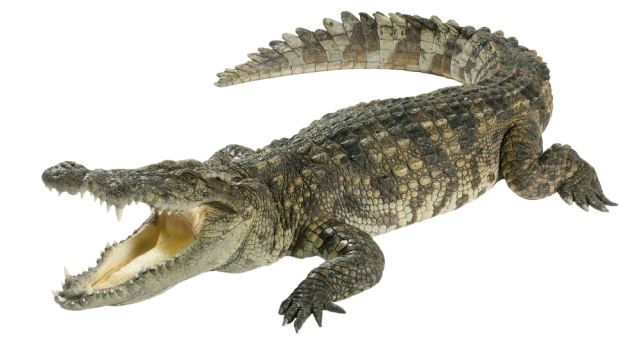
Crocodiles (family Crocodylidae) or true crocodiles are large semiaquatic reptiles that live throughout the tropics in Africa, Asia, the Americas and Australia. The term crocodile is sometimes used even more loosely to include all extant members of the order Crocodilia, which includes the alligators and caimans (family Alligatoridae), the gharial and false gharial (family Gavialidae) among other extinct taxa.
A fish is any member of a group of animals that consist of all gill-bearing aquatic craniate animals that lack limbs with digits. They form a sister group to the tunicates, together forming the olfactores. Included in this definition are the living hagfish, lampreys, and cartilaginous and bony fish as well as various extinct related groups. Tetrapods emerged within lobe-finned fishes, so cladistically they are fish as well. However, traditionally fish are rendered obsolete or paraphyletic by excluding the tetrapods (i.e., the amphibians, reptiles, birds and mammals which all descended from within the same ancestry). Because in this manner the term "fish" is defined negatively as a paraphyletic group, it is not considered a formal taxonomic grouping in systematic biology. The traditional term pisces (also ichthyes) is considered a typological, but not a phylogenetic classification. The earliest organisms that can be classified as fish were soft-bodied chordates that first appeared during the Cambrian period. Although they lacked a true spine, they possessed notochords which allowed them to be more agile than their invertebrate counterparts. Fish would continue to evolve through the Paleozoic era, diversifying into a wide variety of forms. Many fish of the Paleozoic developed external armor that protected them from predators. The first fish with jaws appeared in the Silurian period, after which many (such as sharks) became formidable marine predators rather than just the prey of arthropods. Most fish are ectothermic ("cold-blooded"), allowing their body temperatures to vary as ambient temperatures change, though some of the large active swimmers like white shark and tuna can hold a higher core temperature. Fish are abundant in most bodies of water. They can be found in nearly all aquatic environments, from high mountain streams (e.g., char and gudgeon) to the abyssal and even hadal depths of the deepest oceans (e.g., gulpers and anglerfish). With 33,100 described species, fish exhibit greater species diversity than any other group of vertebrates. Fish are an important resource for humans worldwide, especially as food. Commercial and subsistence fishers hunt fish in wild fisheries (see fishing) or farm them in ponds or in cages in the ocean (see aquaculture). They are also caught by recreational fishers, kept as pets, raised by fishkeepers, and exhibited in public aquaria. Fish have had a role in culture through the ages, serving as deities, religious symbols, and as the subjects of art, books and movies.
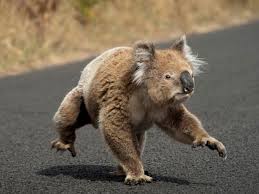
The koala (Phascolarctos cinereus), sometimes called the koala bear, is an arboreal herbivorous marsupial native to Australia. It is the only extant representative of the family Phascolarctidae and its closest living relatives are the wombats. The koala is found in coastal areas of the mainland's eastern and southern regions, inhabiting Queensland, New South Wales, Victoria, and South Australia. It is easily recognisable by its stout, tailless body and large head with round, fluffy ears and large, dark nose. The koala has a body length of 60–85 cm (24–33 in) and weighs 4–15 kg (9–33 lb). Fur colour ranges from silver grey to chocolate brown. Koalas from the northern populations are typically smaller and lighter in colour than their counterparts further south. These populations possibly are separate subspecies, but this is disputed.
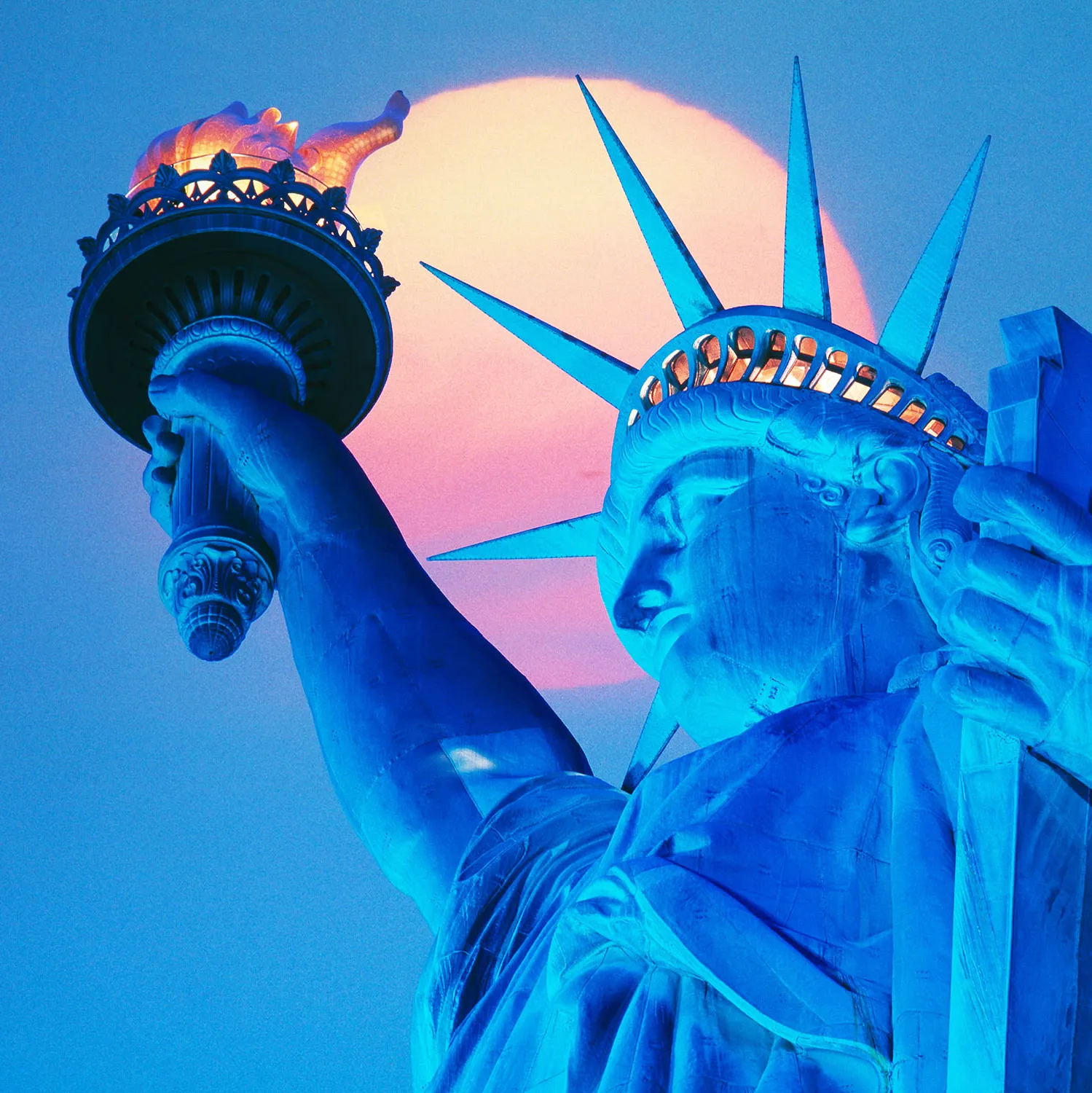
A statue is a free-standing sculpture in which the realistic, full-length figures of persons or animals are carved or cast in a durable material such as wood, metal or stone. Typical statues are life-sized or close to life-size. A sculpture that represents persons or animals in full figure, but that is small enough to lift and carry is a statuette or figurine, whilst those that are more than twice life-size are regarded as colossal statues.